Crack Inspection Melbourne.

The Complete Guide to Structural Cracks, Building Movement, Inspection Costs and When to Engage a Structural Engineer

Sheer Force Engineering · Structural engineers for existing buildings · Melbourne

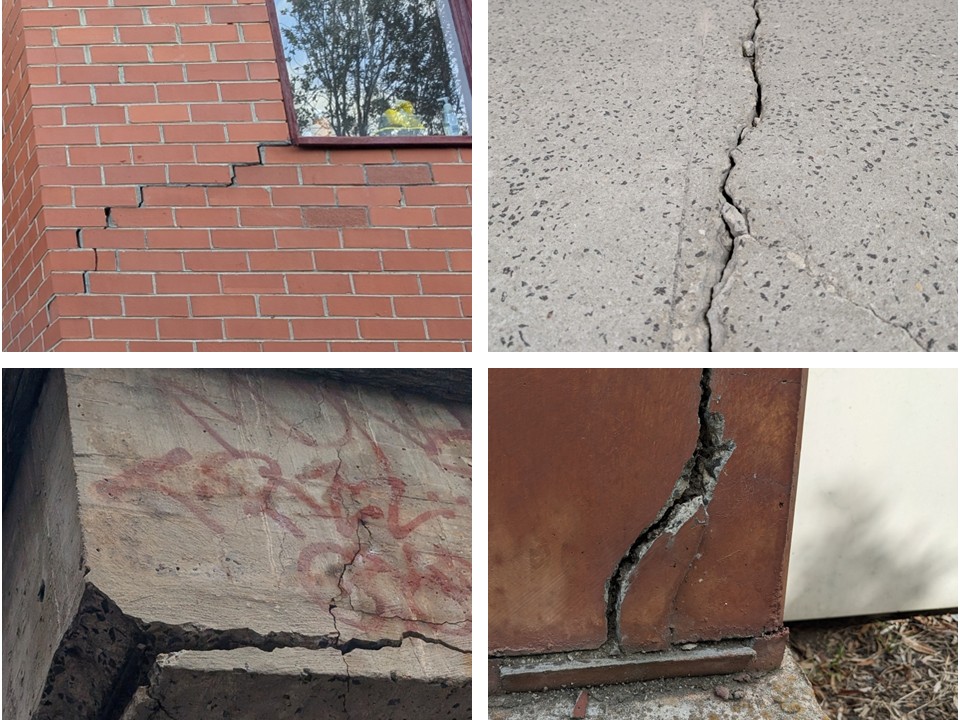
Examples of structural cracking including brick wall cracking, concrete cracking, masonry deterioration and significant structural movement.

Examples of cracking encountered during structural inspections. The location, direction, width and pattern of a crack often provide valuable clues about what is causing it.

Concerned About Significant Cracking?

If a wall is leaning, cracks are rapidly worsening, doors or windows are becoming difficult to operate, or you have concerns about structural safety, we recommend obtaining professional advice as soon as possible.

Need help understanding whether a crack is serious?

Otherwise, continue reading to learn what causes cracks, when they matter and what a structural engineer looks for during a crack inspection.

01

You've Found A Crack. What Happens Next?

If you've arrived on this page, there's a good chance you've noticed cracking in your building and you're wondering what it means.

Does Any Of This Sound Familiar?

  • Cracking in a brick wallCracking in a brick wall
  • Stair-step cracking in masonryStair-step cracking in masonry
  • Cracks in plasterboardCracks in plasterboard
  • Cracks in a concrete slabCracks in a concrete slab
  • Cracking around windows and doorsCracking around windows and doors
  • Cracks near footingsCracks near footings
  • Doors and windows becoming difficult to operateDoors and windows becoming difficult to operate
  • Signs that part of the building may be movingSigns that part of the building may be moving

The first thing to know is that not all cracks are a cause for concern.

Some are cosmetic.

Others can indicate movement, deterioration or structural issues that warrant further investigation.

The purpose of a crack inspection is not simply to measure the crack.

The purpose is to understand why it has occurred and whether any action is required.

Here's What We're Looking For During A Crack Inspection

  • Crack size and progression
  • Signs of building movement
  • Leaning walls
  • Doors and windows sticking
  • Foundation behaviour
  • Moisture-related damage
  • Structural loading
  • Previous repairs and alterations

The Most Expensive Crack Repair Is Often The Wrong One

One of the most common mistakes we see is spending money repairing a crack before understanding what caused it.

A crack caused by deteriorated mortar requires a very different solution to a crack caused by footing movement.

That's why diagnosis comes first.

Many cracks are cosmetic.

Others may indicate movement, deterioration or loss of structural integrity.

Understanding the difference is the first step.

02

When Should You Worry About A Crack?

Not every crack is serious.

However some crack types warrant further investigation. Our earlier article on how you can tell if a crack is structural sets out the crack widths engineers use as a starting point.

Most of the time, the question is not how wide a crack is today.

The question is whether the crack is changing, and whether anything else in the building is moving with it.

Crack Monitoring Tip

One of the most useful things a building owner can do is photograph a crack with a ruler or coin beside it.

Record the date and repeat the photograph several months later.

A crack that has remained stable behaves very differently from one that is actively growing.

In many cases, the change in a crack is more important than the crack itself.

Worth Monitoring Or Investigating

  • Cracks wider than 5 mm

    Once a crack passes roughly 5 mm it is worth measuring and recording rather than filling, because width at this scale usually reflects real movement somewhere.

  • Cracks are growing

    A crack that is longer, wider or newly branching compared with your earlier photographs tells us the cause is still active.

  • New cracking appears suddenly

    Cracking that appears over days or weeks, rather than gradually over years, points to a recent change such as a leak, a load change or ground movement.

  • Cracking is associated with water damage

    Damp staining, efflorescence or blistered paint alongside a crack often means water is driving deterioration behind the surface.

Seek Professional Advice Promptly

  • Walls appear to be leaning

    Out-of-plumb masonry is a stability question, not a finish defect, and it should be assessed rather than monitored.

  • Doors or windows are sticking

    Frames that have racked out of square suggest the structure around them has distorted, not just the finishes.

  • Brickwork is bulging

    Bulging or bowing brickwork can indicate loss of restraint, corroded wall ties or lateral pressure on the wall.

  • Cracking has appeared following nearby construction works

    Excavation, piling, vibration or dewatering next door can change ground support. Early records matter for both safety and liability.

Examples We Would Usually Investigate Further

Wide structural crack through masonry, measured during inspection
Wide cracking. Once a crack passes roughly 5 mm it should usually be measured, monitored and assessed rather than simply filled.
Masonry wall with stair-step cracking, horizontal cracking and sideways wall movement near the parapet
Significant step cracking, horizontal cracking and wall movement. A combination of multiple symptoms is often more important than any individual crack.

Quick Rule Of Thumb

As a general rule, a stable crack that has not changed for years is often less concerning than a crack that is actively growing.

Movement frequently matters more than crack width.

Not All Cracks Are The Same

Understanding what causes cracking is often the first step toward determining whether action is required.

In the next section we explore the different crack types we commonly encounter and what they can tell us about a building.

Visual Severity Guide

How Serious Is Your Crack?

This guide is a starting point, not a diagnosis. It reflects how we prioritise attention when we first walk a building, and every band assumes the crack is read alongside building movement, drainage and history.

Green

Usually Cosmetic

Fine hairline cracking in paint, plaster or render finishes. Typically stable, seasonal, and addressed through ordinary maintenance.

Fine hairline crack in an internal plaster wall near the ceiling
Hairline plaster cracking. Often cosmetic and commonly repaired during routine maintenance.
Paint film cracking and flaking away from a rendered wall
Paint film cracking and coating deterioration. Usually a maintenance issue rather than a structural concern.
Yellow

Monitor

Minor cracking that reappears after repair, or small masonry cracks that may reflect seasonal movement. Record widths and dates before spending money.

Minor recurring crack in a masonry wall
Minor recurring cracks.
Localised fine cracking through the mortar joints of a brick wall
Localised masonry cracking. Worth recording and monitoring if it continues to reappear or widen over time.
Orange

Seek Advice

Patterns that indicate relative movement between parts of the building. Worth an engineer's assessment before any repair is specified.

Stair-step cracking through the mortar joints of a brick wall below a window
Stair-step masonry cracking often indicates relative movement between different parts of a building.
Wide diagonal crack running across an internal wall
Diagonal cracking can indicate structural movement, settlement or building distortion and is often worth investigating.
Red

Urgent Assessment Recommended

Leaning, bulging or displaced masonry, rapidly widening cracks, or any sign that an element is losing the ability to carry load. Seek advice immediately.

Digital level held against a masonry wall showing it is out of plumb
Out-of-plumb walls and visible lean may indicate structural instability and warrant prompt assessment.
Bulging and displaced brickwork viewed along the face of a wall
Bulging masonry can indicate loss of restraint and should generally be assessed by a structural engineer.

Important

No crack should be assessed in isolation. Crack width, location, movement, building type, age, moisture exposure and building history all influence the level of concern. Where significant movement, distortion or ongoing cracking is present, professional assessment is recommended.

03

Which Cracks Are Usually Cosmetic?

Paint cracking. Paint films are thin and brittle compared with the substrate beneath them. Repeated cycles of heat, cold and humidity crack the film long before anything structural is affected. Paint cracking that does not continue into the plaster or masonry behind it is a decorating matter.

Plaster shrinkage. Plaster and plasterboard sets shrink as they dry and continue to move seasonally with the timber framing around them. Fine cracks at cornices, wall junctions and above openings are extremely common in Melbourne homes, particularly in the first few years after new work.

Minor settlement. Almost every building settles a little as it takes up its own weight and the soil beneath it adjusts. Where that settlement is small and even, the resulting hairline cracking stabilises and does not progress.

Surface rendering cracks. Render and stucco are applied coatings with different stiffness and shrinkage characteristics to the wall behind. Map cracking, crazing and fine linear cracks in render are usually confined to the coating, though render can also conceal significant masonry defects, so it is worth confirming what lies behind it.

Cosmetic cracking can often remain stable for years. Not every crack requires engineering intervention. The practical test is whether the crack is changing, and whether it is accompanied by any distortion of the building itself.

Fine hairline crack in an internal plaster wall
Hairline plaster cracking. Often cosmetic and commonly repaired during routine maintenance.
Cracked and peeling paint film on a painted wall surface
Paint film cracking and coating deterioration. Usually a maintenance issue rather than a structural concern.
Minor recurring crack recorded on a wall for monitoring
Minor recurring cracking. Often suitable for monitoring where no additional movement is present.
Small localised crack in a brick masonry wall
Localised masonry cracking. Worth recording and monitoring if it continues to reappear or widen over time.

Usually Cosmetic Does Not Mean Ignore Forever

Most cosmetic cracks remain stable for many years and can often be repaired as part of routine maintenance.

However, any crack that is actively changing, widening or becoming associated with other symptoms should be reassessed.

The distinction is often not whether a crack exists, but whether it is continuing to move.

04

Which Cracks Need Investigation?

Stair-step cracking. A crack that steps diagonally through mortar joints means the wall has parted along its weakest path. It usually reflects differential movement, mortar deterioration, or both acting together.

Diagonal cracking. Diagonal cracks from the corners of openings indicate distortion. Openings are the weak points in a wall, so they are where movement declares itself first.

Horizontal cracking. Horizontal cracks along bed joints can indicate lateral load, corroding wall ties or lintels, brick growth against a rigid restraint, or loss of restraint at the top of a wall. They deserve prompt attention.

Leaning walls. A wall out of plumb has already moved. The question becomes whether it is still moving, and whether the wall retains adequate stability and restraint in its current position.

Bulging masonry. Bulging often indicates that a wall has begun to separate through its thickness, that ties have corroded, or that a solid wall is delaminating. It is a stability issue rather than an appearance issue.

Cracks associated with movement. Cracking that appears with sticking doors, sloping floors, gaps opening at skirtings or cornices, or masonry displaced out of line is evidence that the structure itself has changed shape.

The Pattern Is Often More Important Than The Crack

Engineers rarely assess cracking in isolation.

Crack width, location, direction, associated movement, moisture exposure and building history all contribute to the diagnosis.

Two cracks that appear visually similar can have completely different causes and require very different solutions.

This is why professional assessment focuses on the overall pattern of symptoms rather than any individual crack.

Long crack running through a concrete basement car park slab
Some concrete cracks develop as part of restrained shrinkage. Determining whether movement is ongoing is often the key question.
Cracking above a doorway extending across a wall and into the ceiling
Significant cracking around openings and through walls may indicate movement within the building and should generally be assessed.
Cracking with leaching and moisture staining across a concrete soffit
Cracking through structural concrete elements may warrant investigation, particularly where moisture ingress or movement is present.

Not Sure Whether Your Crack Is Serious?

Many building owners struggle to determine whether cracking is cosmetic or evidence of a more significant issue.

A structural engineer can often identify the likely cause and provide practical advice on the next steps.

05

Why Do Buildings Crack?

Buildings crack because something has moved, expanded, contracted, corroded or lost strength. In Melbourne, eight causes account for the overwhelming majority of the cracking we are asked to investigate — and more than one is usually at work. Concrete behaves differently again, and we cover that in detail in why concrete slabs crack.

Foundation Settlement

Uniform settlement rarely damages a building, because the whole structure moves together. Damage comes from differential movement, where one part settles more than another and the structure is forced to distort.

Melbourne's reactive clay soils shrink in dry weather and swell when wet, so footings can rise and fall seasonally. Older shallow footings, extensions built on different footing systems, and poorly drained sites are the usual candidates.

Differential movement

Moisture Ingress

Water is the single most destructive influence on an existing building. It erodes lime mortar, softens masonry, corrodes wall ties and reinforcement, rots timber and changes the volume of soil beneath footings.

Leaking plumbing, blocked or disconnected stormwater, failed flashings, poor site falls and failed waterproofing regularly sit behind cracking that first appears to be structural.

Material weakening

Brick Growth

Fired clay bricks slowly reabsorb moisture after manufacture and permanently expand over decades. The movement is small per metre but significant across a long wall.

Where articulation joints are absent — as in most older masonry — that expansion has nowhere to go, and it appears as vertical cracking at corners and junctions, or horizontal cracking where the wall pushes against a rigid element.

Long-term expansion

Mortar Deterioration

In solid masonry, the mortar transfers load between bricks and holds the wall together as a single element. When lime mortar washes out or turns to sand, the wall loses its integrity from within.

This is one of the most commonly missed causes of heritage cracking. We have investigated buildings underpinned repeatedly where the real problem was mortar loss hidden behind render.

Loss of wall integrity

Corrosion

Steel expands as it rusts, occupying several times its original volume. Embedded lintels, wall ties, reinforcement and structural steelwork therefore split the material around them as they corrode.

The tell-tale signs are cracking that follows a straight line above an opening, rust staining, spalling concrete or displaced brick courses. Corrosion damage is progressive and does not stabilise on its own.

Expansive rusting steel

Structural Alterations

Removing a wall, opening up a kitchen, taking out a chimney or adding a level changes where load travels. If the new path is inadequate or the supporting elements deflect, cracking follows.

Alteration-related cracking often appears within months of the work, close to new beams or removed walls, and can usually be traced by comparing the current structure with the original arrangement.

Changed load paths

Tree Influence

Large trees draw significant volumes of moisture from the soil, and on reactive clay that drying causes localised shrinkage and settlement of nearby footings.

Removing a mature tree can produce the reverse effect, with the soil rehydrating and heaving over several years. Tree influence is real, but it is also frequently blamed when other causes dominate.

Soil moisture change

Construction Activities

Excavation beside an existing building removes lateral support, lowers groundwater and can allow adjacent soil to move. Piling, rock breaking and heavy plant add vibration.

Cracking that appears suddenly while neighbouring works are underway should be documented immediately, ideally against a pre-construction dilapidation record.

Excavation and vibration

Large street tree growing close to a two-storey masonry building in Melbourne
Large trees can significantly influence moisture conditions in reactive soils and contribute to seasonal footing movement.
Concrete showing alkali-silica reaction cracking
Material deterioration in concrete produces its own crack patterns.
Corroded reinforcement exposed in a spalled concrete column with cracking through the surrounding concrete
Corroding reinforcement expands as it rusts, generating cracking, spalling and progressive deterioration of the surrounding concrete.

06

Common Types Of Cracks We Inspect

Every crack type below carries a typical level of concern, but the level shifts with width, progression and what else the building is doing. Use it to understand what you are looking at, not to rule a crack out.

Stair-step crack tracking diagonally through the mortar joints of a brick wall
Stair-step cracking following mortar joints is one of the clearest indicators of differential movement in masonry walls.

Stair-Step Cracks

Cracking that steps diagonally through the mortar joints, following the weakest path through the wall. It is one of the clearest signals that part of a wall has moved relative to the rest of it.

Likely causes

  • Differential foundation movement
  • Reactive clay soils drying and swelling
  • Mortar deterioration along a bed joint
  • Localised overloading above an opening
Vertical crack opening through brickwork at a wall junction
Vertical cracking commonly appears at building junctions, corners and long unarticulated wall sections.

Vertical Cracks

Cracks running up and down a wall, frequently at junctions, corners or long unarticulated runs of brickwork. Width, taper and whether the crack passes through bricks or joints tell you a great deal.

Likely causes

  • Clay brick growth with no articulation joint
  • Shrinkage of concrete or render
  • Wall junctions with differing stiffness
  • Thermal movement of long walls
Wide diagonal crack running across an internal wall
Diagonal cracking often forms as buildings distort and stress concentrates around openings.

Diagonal Cracks

Cracks running at roughly 45 degrees, commonly from the corners of windows and doors. Openings concentrate stress, so diagonal cracks often reveal the direction a building is moving.

Likely causes

  • Differential settlement or heave
  • Lintel deflection or corrosion
  • Excavation or vibration nearby
  • Removal of a load-bearing element
Horizontal crack running along a wall below the ceiling line
Horizontal cracking often indicates lateral pressure, loss of restraint or corrosion-related expansion.

Horizontal Cracks

Cracking along a bed joint, sometimes with the wall above displaced sideways. Horizontal cracks can indicate lateral pressure, corrosion of embedded metal, or loss of restraint at the top of a wall.

Likely causes

  • Soil or water pressure on a retaining wall
  • Corroding wall ties or lintels expanding
  • Loss of roof or floor restraint
  • Brick growth against a rigid element
Cracking and spalling along a joint in a concrete slab
Concrete cracking can arise from shrinkage, curing effects, loading or durability-related deterioration.

Concrete Cracks

Concrete cracks for many reasons, and only some of them matter structurally. Pattern, timing, width and whether reinforcement is exposed separate a curing artefact from a durability problem.

Likely causes

  • Plastic settlement and shrinkage
  • Restrained drying shrinkage
  • Reinforcement corrosion and spalling
  • Flexural overload or deflection
Cracked solid brick masonry on a heritage Melbourne building
Heritage masonry often behaves differently to modern construction and requires careful interpretation.

Heritage Masonry Cracks

Solid brick heritage walls carry load through the masonry itself, so lime mortar loss, damp and past alterations matter more than in modern construction. Heritage cracking is frequently misread as footing failure.

Likely causes

  • Lime mortar erosion and washout
  • Rising or falling damp
  • Previous unsympathetic repairs
  • Removal of internal walls or chimneys
Cracking along a ceiling and cornice line in a period room
Ceiling cracking is often associated with plaster movement, framing movement or localised structural distortion.

Ceiling Cracks

Most ceiling cracks are plaster and cornice movement caused by seasonal timber shrinkage. Cracks that follow a joist line, sag, or coincide with wall cracking deserve a closer look.

Likely causes

  • Timber shrinkage and seasonal movement
  • Plasterboard joint or set failure
  • Roof or truss deflection
  • Water damage from above
Cracking across an exposed concrete balcony slab during investigation
Balcony cracking may indicate durability problems, waterproofing failures or reinforcement deterioration.

Balcony Cracks

Balconies are exposed, thin and frequently the first element where water reaches reinforcement. Cracking along the slab edge or soffit is a durability and safety matter, not a finish defect.

Likely causes

  • Failed waterproofing membranes
  • Reinforcement corrosion and spalling
  • Inadequate cover to steel
  • Structural deflection at the cantilever
Cracked concrete footing exposed beside a brick wall
Foundation cracking should always be interpreted alongside soil behaviour, drainage and footing type.

Foundation Cracks

Cracking in slabs, footings or basement walls needs to be read against the soil, drainage and footing type. The crack is a symptom; the ground conditions usually hold the explanation.

Likely causes

  • Differential settlement on reactive soils
  • Poor site drainage or plumbing leaks
  • Inadequate or shallow original footings
  • Adjacent excavation removing support

Crack Width Guide

Crack width is only one part of the assessment process, however it can provide a useful starting point when deciding whether monitoring or further investigation is appropriate.

Approximate crack width and general guidance
Approximate crack widthGeneral guidance
Hairline (< 0.5 mm)Usually monitor and record. Common in plaster, paint and render finishes.
0.5 mm - 1 mmMonitor for change. Photograph and record location.
1 mm - 5 mmConsider engineering advice depending on location, progression and building type.
Greater than 5 mmInvestigation is generally recommended.
Rapidly changing crack (any width)Seek professional assessment promptly.

Important

Crack width alone does not determine severity. Location, crack pattern, building type, movement history, moisture exposure and the presence of other symptoms are often just as important as the width of the crack itself. Two cracks of the same width can have very different causes and require very different responses.

07

What Happens During A Crack Inspection?

  1. 1

    Initial discussion

    We start with a conversation. When did the cracking appear, is it changing, what work has been done to the building, and what outcome do you actually need? This often shapes the scope before anyone attends site.

  2. 2

    Site inspection

    An engineer attends and walks the building inside and out, including subfloor, roof space and external ground levels where accessible. Drainage, ground falls, vegetation and neighbouring works are all part of the picture.

  3. 3

    Crack assessment

    Each significant crack is located, measured, photographed and described by direction, taper and whether it passes through units or joints. Crack widths are recorded against a gauge so future readings are comparable.

  4. 4

    Building assessment

    We check wall plumbness, floor levels, distortion of openings, the load path and any evidence of past alterations. The pattern across the whole building usually reveals the cause more clearly than any single crack.

  5. 5

    Investigation where required

    Where the cause remains uncertain, targeted investigation follows: removing render or linings at selected points, mortar assessment, moisture readings, drainage testing, footing exposure, survey levels or crack monitoring over time.

  6. 6

    Advice and recommendations

    You receive a plain explanation of what is causing the cracking, how serious it is, and what should be done — including where the appropriate answer is to monitor and do nothing further for now.

  7. 7

    Optional reporting

    If you need documentation for a builder, an owners corporation, an insurer, a purchaser or a dispute, we prepare a written report. Many inspections conclude with verbal advice alone.

Crack width gauge installed across a crack to monitor movement
Crack width gauges establish whether a crack is stable or progressing before repairs are specified.
Structural engineer undertaking a site investigation on a Melbourne building
Site investigation on an existing Melbourne building.

08

How Much Does A Crack Inspection Cost In Melbourne?

Localised Inspection

A single crack or one area of concern, with straightforward access.

$850 + GST

Typical client

Homeowners

  • Site visit
  • Visual inspection
  • Verbal advice

Residential Inspection and Written Summary

A house or unit where you need something in writing to act on.

$850 – $2,000 + GST

Typical client

Homeowners, property buyers and vendor reports

  • Site visit
  • Written advice
  • Recommendations

Detailed Residential Investigation

Widespread cracking, multiple causes, or a dispute over the diagnosis.

$2,000 – $5,000+

Typical client

Properties with widespread cracking, multiple defects or disputes about the cause

  • Detailed assessment
  • Structural review
  • Cause analysis

Commercial Crack Investigation

Apartment buildings, heritage assets, commercial and industrial sites.

$5,000 – $10,000+

Typical client

Owners corporations, commercial buildings and heritage assets

  • Complex investigations
  • Larger sites

Forensic Structural Investigation

Matters heading toward insurance, litigation or expert evidence.

$10,000+

Typical client

Complex structural issues, expert reports and major deterioration investigations

  • Monitoring
  • Testing
  • Detailed reporting

Every project is different. Fees vary depending on building size, complexity, access and reporting requirements.

09

Do Cracks Always Mean Underpinning?

No.

One of the most common misconceptions is that cracking automatically means the footings have failed.

In reality, cracking can be caused by:

Cracked and displaced painted brickwork at the base of a wall
Cracking can occur for many reasons. In this example, the cause is unlikely to be footing failure alone.

Mortar Deterioration

Historic lime mortars often weaken long before the surrounding brickwork.

Moisture Issues

Leaks, poor drainage and changes in moisture conditions can all contribute to cracking.

Building Modifications

Removing walls, enlarging openings and structural alterations can change load paths.

Brick Growth

Clay bricks slowly expand over time and can generate significant cracking.

Corrosion

Expanding rusting steel can crack both masonry and concrete.

Structural Overloading

Additional loads sometimes create localised cracking without any footing movement.

Engineering Insight

A Proper Diagnosis Should Come Before Any Repair Recommendation

Underpinning is expensive, disruptive and, when applied to the wrong problem, entirely ineffective.

Where footing movement genuinely is the cause, underpinning may be exactly the right solution.

However, the diagnosis should follow evidence, not precede it.

Many building owners are surprised to discover that cracking is often caused by issues such as mortar deterioration, moisture changes, brick growth, corrosion or building alterations rather than footing failure alone.

11

Frequently Asked Questions

Should I worry about cracks?
Sometimes. Fine hairline cracking in paint, plaster or render is extremely common in Melbourne buildings and often stays stable for years. You should take cracking more seriously when it is wider than about 5 mm, when it is clearly growing, when walls are leaning or bulging, when doors and windows begin to stick, or when it appears suddenly. Those signals suggest movement rather than a surface finish problem.
What causes cracks in walls?
Wall cracking is caused by movement, expansion, contraction or loss of material integrity. In practice the common causes are foundation settlement on reactive clay soils, moisture ingress, long-term clay brick growth, mortar deterioration, corrosion of embedded steel, structural alterations that changed the load path, tree root activity drying out soil, and vibration or excavation from nearby construction.
How much does a crack inspection cost?
A localised inspection with a site visit, visual assessment and verbal advice typically starts around $850 + GST. A residential inspection with a written summary and recommendations usually falls between $850 and $2,000 + GST. Detailed residential investigations range from $2,000 to $5,000 or more, commercial crack investigations from $5,000 to $10,000 or more, and full forensic investigations involving monitoring, testing and detailed reporting exceed $10,000. Fees depend on size, complexity, access and reporting requirements.
Can cracks be repaired?
Yes, but repair should follow diagnosis. Repairing a crack without understanding why it formed usually means the crack returns. Depending on the cause, appropriate work might include repointing, crack stitching, helical tie reinstatement, articulation joints, drainage improvements, concrete repair, structural strengthening or, in some cases, footing works.
Do cracks always mean underpinning?
No. Underpinning is one possible response to one possible cause. Many of the cracks we investigate are caused by mortar deterioration, brick growth, moisture, corrosion, building modifications or overloading, and underpinning would not help at all. We have inspected buildings underpinned several times that continued to move because the actual cause was never identified.
What is stair-step cracking?
Stair-step cracking is a crack that steps diagonally through the mortar joints of a masonry wall, following the joints rather than passing straight through the bricks. It generally means one part of the wall has moved relative to another, and it is one of the more meaningful crack patterns for an engineer to assess.
Are cracks in brick walls serious?
It depends on width, pattern, direction and whether the crack is progressing. Fine vertical cracking in mortar joints on a long wall may simply reflect brick growth or thermal movement. Stair-step or horizontal cracking, cracking associated with bulging, or brickwork that has visibly displaced usually warrants professional assessment.
Can trees cause cracks?
Yes. Trees close to a building draw moisture out of the soil, and on reactive clay soils that shrinkage can settle footings unevenly. Removing a large established tree can also cause the opposite effect, with soil rehydrating and heaving over several years. Tree influence is a genuine cause of cracking, though it is often blamed when other factors are at work.
Can moisture cause cracks?
Yes, and it is one of the most under-diagnosed causes we encounter. Moisture erodes lime mortar, softens masonry, corrodes wall ties and reinforcement, swells timber, and changes soil volume beneath footings. Leaking plumbing, blocked stormwater, poor site drainage and failed waterproofing frequently sit behind cracking that appears structural.
Can cracks affect property value?
Visible cracking can affect buyer confidence, negotiation and insurance or lending decisions, particularly where no explanation exists. A clear engineering assessment often protects value by establishing what the cracking is and is not, and what, if anything, needs to be done about it.
How long does a crack inspection take?
A typical residential site inspection takes one to two hours on site. Larger or more complex buildings, multiple tenancies or difficult access can take a full day. Where monitoring is recommended, readings are usually taken over several months so that seasonal movement can be separated from progressive movement.
Do I need a report?
Not always. Many inspections begin with a site visit and verbal advice, which is enough for an owner who simply needs to know whether cracking is serious. A written report becomes valuable when you need to instruct a builder, satisfy an owners corporation, support an insurance or dispute matter, or record a baseline for future comparison.
Can heritage buildings crack without settlement?
Yes, and it is common. Solid masonry heritage buildings crack because of lime mortar loss, damp, clay brick growth, corroding iron and steel, and past alterations such as removing chimneys or internal walls. We regularly investigate heritage cracking where the footings are performing acceptably and the real cause lies in the masonry itself.
What causes concrete cracks?
Concrete cracks from plastic settlement and shrinkage while it is curing, from restrained drying shrinkage afterwards, from thermal movement, from flexural loading and deflection, from reinforcement corrosion expanding within the section, and from durability mechanisms such as alkali-silica reaction. The pattern and timing usually indicate which mechanism is responsible.
Can cracks be monitored?
Yes. Crack width gauges, tell-tales, survey levels and photographic records taken at intervals establish whether a crack is stable or progressing. Monitoring is often the most cost-effective next step where the cause is uncertain, because it distinguishes seasonal movement from ongoing movement before money is spent on repairs.
Do all cracks require engineers?
No. A great deal of cracking is cosmetic and can be filled and painted as part of ordinary maintenance. Engineering advice is worth obtaining when cracking is wide, growing, associated with movement or distortion, affecting a load-bearing element, or when you need certainty before buying, selling or repairing.
What does a structural engineer look for?
We assess crack location, width, direction, taper and whether it passes through units or joints; wall plumbness and floor level; distortion of doors and windows; drainage, damp and ground conditions; the load path and any past alterations; the footing type and soil classification; and any evidence of corrosion or material deterioration. The pattern across the whole building matters more than any single crack.
Can doors sticking indicate movement?
Yes. Doors and windows that suddenly bind, or that have been repeatedly planed and adjusted, are one of the clearest everyday signs that a building has racked or distorted. When sticking appears alongside diagonal or stair-step cracking, it usually indicates real movement rather than swelling from humidity.
What is differential settlement?
Differential settlement is when one part of a building settles more than another. Uniform settlement rarely causes damage, because the whole building moves together. Damage comes from the difference, which forces the structure to distort and cracks to open where it cannot accommodate that distortion.
How quickly should cracks be investigated?
Cracking that is rapidly widening, accompanied by leaning or bulging walls, sagging floors, jammed doors or falling material should be assessed immediately. Stable hairline cracking can reasonably be observed over a season. If you are unsure, photograph the crack with a scale, note the date, and seek advice rather than waiting for it to develop.

Need Help With Cracking In Your Building?

Whether you're concerned about a heritage property, residential home, apartment building or commercial asset, understanding the cause of cracking is often the first step toward an effective solution.