
What a Burst Pipe Taught Us About Foundation Movement, Flooding, and Engineering Evidence
When a homeowner challenged an insurance decision following widespread cracking in their property, we were engaged to investigate what had really happened. Historical records showed the home had remained generally stable for years before a burst pipe flooded the subfloor. Through site inspections, review of previous engineering reports, and analysis of soil behaviour, we found the story was far more complex than simply blaming age or reactive clay. This project highlights why evidence, timelines, and engineering reasoning matter when determining the true cause of building damage.
Quentin Suckling · September 2026 · 6 min read
Some engineering projects are about finding defects.
Others are about finding the truth.
This project fell firmly into the second category.
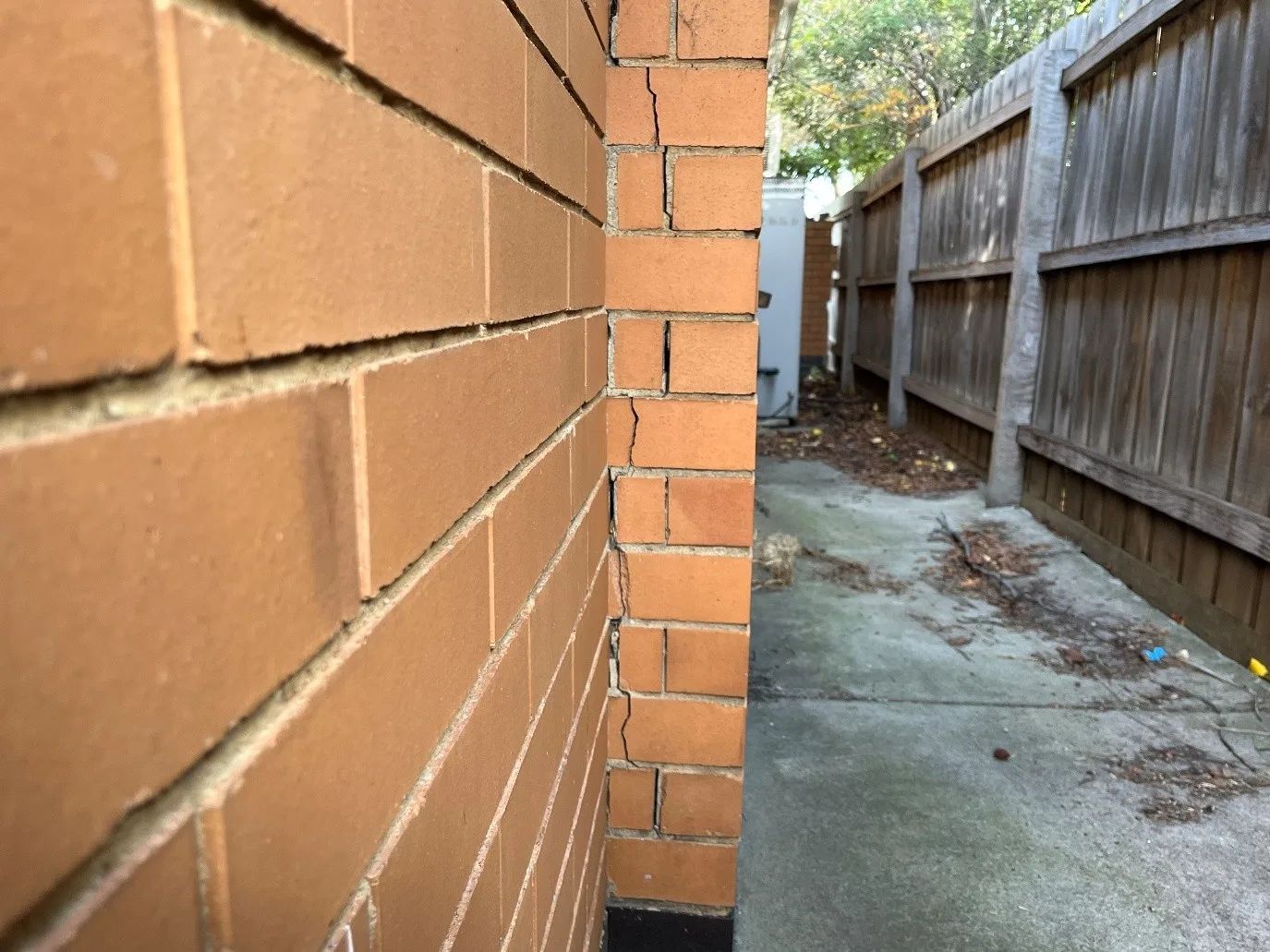
We were engaged by a homeowner who was involved in a dispute with her insurer regarding extensive cracking and movement throughout a residential property. The property had experienced a burst plumbing pipe beneath the home, resulting in significant water accumulation throughout the subfloor. Following the event, widespread cracking, floor movement, sticking doors, wall separations, and masonry damage began appearing throughout the dwelling.
The homeowner's concern was not simply that damage had occurred.
The real concern was whether the explanation being provided for that damage actually matched the available evidence.
What made this project particularly interesting was that the property had something many investigations lack: a detailed historical record. Routine inspections had been undertaken regularly over several years, creating a valuable timeline of the building's condition before and after the plumbing failure.
As engineers, those are the projects we enjoy most.
Not because they are contentious, but because they require careful analysis, objective thinking, and evidence-based conclusions.
Initial Observations
When we arrived at the property, signs of movement were everywhere.
Cracks extended through internal walls and ceilings. Portions of the building had separated. Doors were jamming. Window frames had developed visible gaps from surrounding masonry. Brickwork exhibited cracking and localised deterioration. Floor levels indicated noticeable distortion throughout the dwelling.
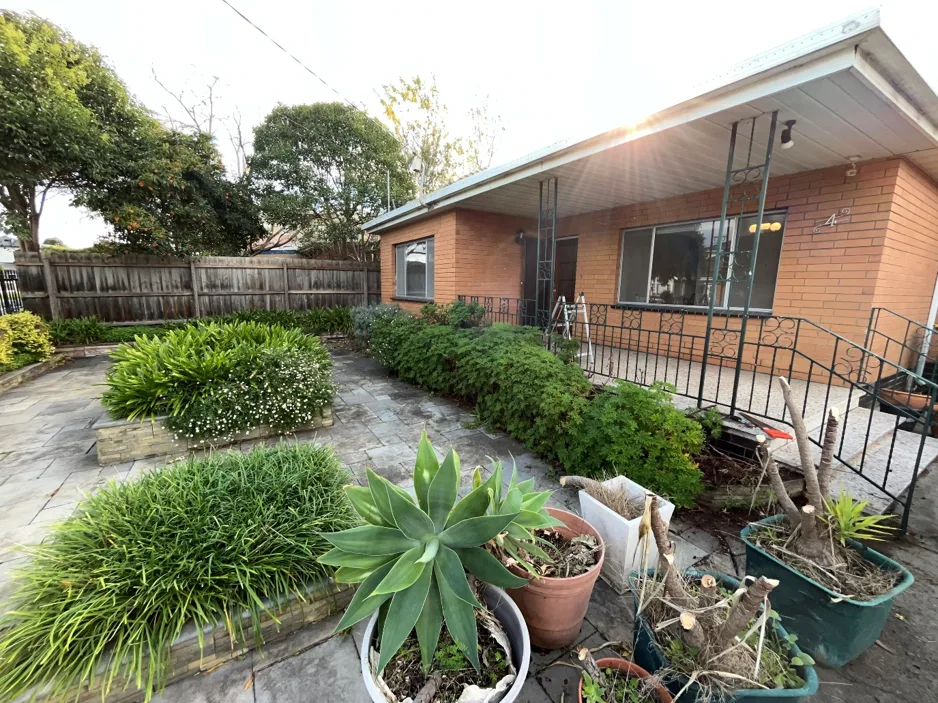
Many homeowners understandably assume that cracking automatically means a building is structurally failing.
In reality, cracks are simply clues.
The job of an engineer is not to focus on the crack itself. Our job is to understand what caused the crack.
A crack is often the symptom.
The cause is usually somewhere else.
In this case, the most significant clues did not exist inside the house at all.
They were hidden underneath it.
Investigating the Real Cause
One of the most valuable engineering skills is resisting the temptation to jump to conclusions.
We started by reviewing the available records.
Those records included:
Historical property inspection reports.
Previous engineering assessments.
Plumbing investigations.
Site measurements.
Floor level surveys.
Subfloor inspections.
Photographic evidence documenting the progression of damage.
The inspection history proved particularly valuable.
Multiple routine inspections between 2023 and early 2025 consistently described the property as being in generally good condition, with no evidence of widespread structural distress. Then, immediately following the plumbing incident, reports began documenting cracking, floor distortion, separations, and movement throughout the dwelling.
From an engineering perspective, timing matters enormously.
If a building remains stable for years and then rapidly develops damage shortly after a significant water event, we need to pay very close attention to that sequence.
What We Found Beneath the House
The house was supported on a traditional timber stump foundation system.
Unlike a modern concrete slab-on-ground house, a stump-supported house contains open space beneath the floor.
That distinction is important.
When the plumbing failure occurred, water was able to accumulate beneath the entire building.
Historical information indicated that approximately 300mm of standing water was present throughout the subfloor area before being pumped out.
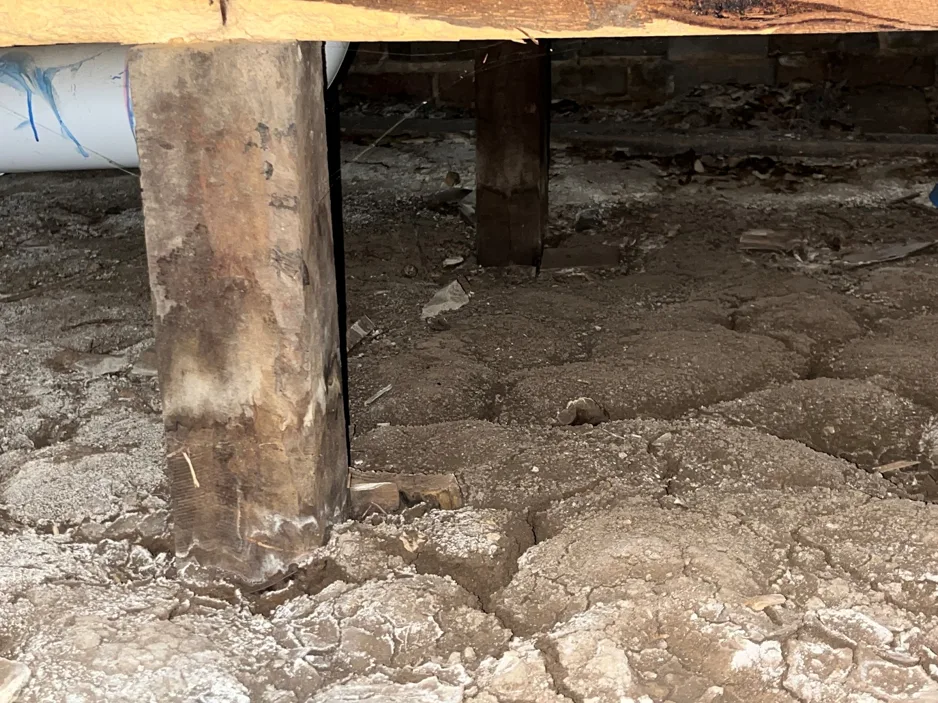
When we inspected beneath the dwelling, we observed widespread evidence of soil saturation, moisture-related deposits, and signs of soil expansion. Floor level measurements aligned with the locations where this behaviour was observed.
This is where understanding reactive clay becomes important.
Reactive clay is common throughout many parts of Victoria.
The easiest way to explain it is to imagine a sponge.
When a sponge absorbs water, it grows.
When it dries, it shrinks.
Reactive clay behaves similarly.
As moisture increases, the soil expands. As moisture decreases, it contracts.
That movement can exert considerable force on foundations and structural elements.
Why Flooding Beneath a House Is Different
Many people think that if rain does not damage a building, a plumbing leak should not either.
The reality is very different.
A rainfall event typically wets the soil surface temporarily.
A prolonged flooding event is another matter entirely.
In this case, water was present beneath the structure for an extended period, creating abnormal moisture conditions throughout the subfloor.
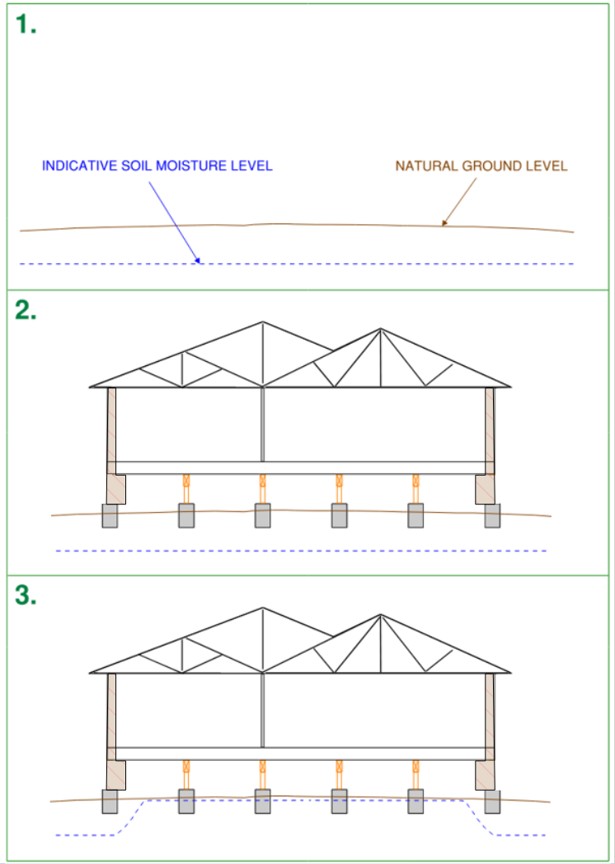
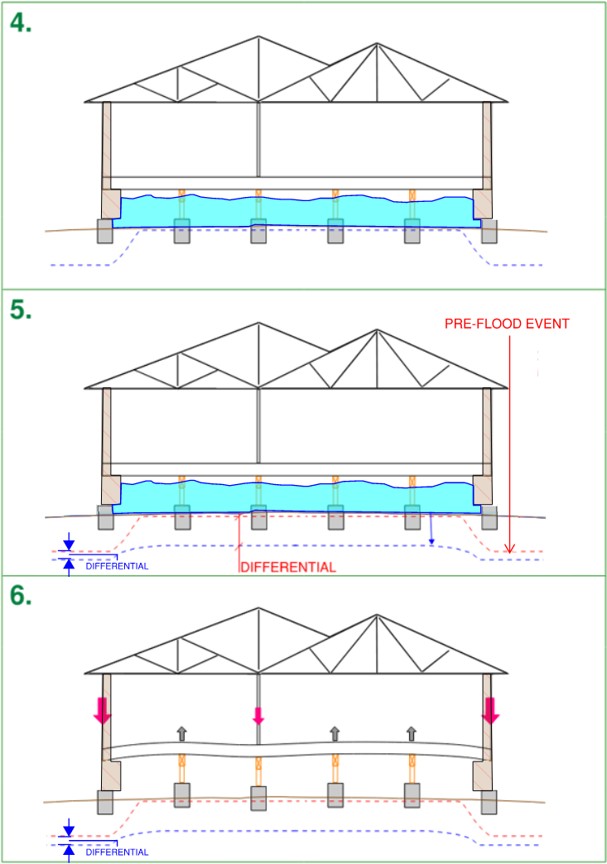
A useful analogy is to imagine lifting the centre of a table while leaving the edges largely unchanged.
The table begins to distort.
Something similar can happen when different areas beneath a building experience different levels of soil expansion.
This phenomenon is known as differential movement.
Put simply, different parts of the structure move by different amounts.
Structures do not like differential movement.
Cracks, separations, and distortions are often the result.
The Importance of Testing Alternative Theories
One of the most interesting aspects of this project was evaluating alternative explanations.
Several potential causes had previously been suggested, including:
Reactive clay behaviour.
Surface drainage issues.
Trees.
Stormwater defects.
Sewer defects.
Age-related deterioration.
Ageing timber stumps.
As engineers, we cannot simply dismiss possibilities.
We have to test them.
That meant assessing site drainage, examining tree locations, reviewing plumbing investigations, and comparing those findings against the documented timeline of events.
Interestingly, many of the factors often blamed for movement were found to have existed long before the damage appeared.
That does not necessarily mean they had zero influence on the building over its lifetime.
However, it does raise an important engineering question:
If these factors were the primary cause, why did the significant damage emerge when it did?
That question became central to our assessment.
Engineering Insights
Cracks Are Not Causes
One of the biggest misconceptions we encounter is that cracks tell you why damage occurred.
They don't.
Cracks tell you that movement happened.
Determining why that movement happened requires evidence, analysis, and context.
Timing Is Often the Strongest Evidence
Buildings tell stories.
The timing of events often provides some of the strongest clues.
In this case, years of generally stable performance followed by damage appearing shortly after a major subfloor water event formed a compelling sequence that deserved careful consideration.
Moisture Is One of a Building's Greatest Enemies
Many people think of structural damage in terms of age or loading.
Yet moisture is one of the most powerful forces affecting residential buildings.
It can alter soil behaviour, accelerate deterioration, and create conditions that dramatically change how a structure behaves.
Insurance Reports Are Still Engineering Opinions
A broader lesson from this project is that engineering reports should always be evaluated on the strength of their evidence and reasoning.
An engineering opinion is exactly that: an opinion.
A good engineering opinion is supported by facts, observations, measurements, and logic.
When significant consequences are involved, obtaining an independent assessment can often be worthwhile.
The Outcome
Following our investigation, we concluded that the burst pipe and resulting subfloor inundation provided a credible mechanism capable of explaining the nature, timing, and distribution of damage observed throughout the property.
The homeowner was seeking clarity rather than certainty.
Our role was not to advocate.
Our role was to assess the available evidence objectively and provide engineering conclusions supported by the information available.
At the time of writing, the broader insurance dispute remains ongoing.
However, the engineering investigation helped ensure that the discussion was focused on evidence rather than assumptions.
Key Takeaways
Cracking does not automatically mean structural failure.
The timeline of damage is often as important as the damage itself.
Reactive clay can behave dramatically when abnormal moisture events occur.
Water beneath a house can be far more damaging than many homeowners realise.
Historical inspection records can become some of the most valuable evidence during an investigation.
If something does not appear to add up, obtaining an independent engineering opinion may help clarify the situation.
Tagged
Never miss a new insight.
Receive email notifications when new articles, project lessons and technical insights are published.
Leave a message.
A thought, a question or a correction on this article — it comes straight to our team. Messages are reviewed by us before they appear beneath the article.
Tell us about your building.
Can’t find the answer you’re looking for? Tell us about your building, project or challenge and we’ll help point you in the right direction.
About The Author

Quentin Suckling
Director - Structural Engineering
Quentin Suckling is the Director and Principal Structural Engineer at Sheer Force Engineering. Passionate about heritage preservation and adaptive reuse, he enjoys understanding how buildings behave and helping clients unlock the potential within existing structures. Through these articles he shares practical lessons from projects, investigations and engineering practice.